

A player clicks an ad promising a welcome bonus. The page loads with three overlapping pop-ups. The bonus amount is highlighted in neon, but the wagering terms are nowhere to be found. The withdrawal policy is buried in a footer link that barely loads on mobile. The player closes the tab. This sequence happens thousands of times per day across casino campaigns, and most operators miss it because they’re tracking traffic volume instead of what happens in the first 15 seconds.
Casino landing pages carry a uniquely high burden of proof. Players aren’t deciding whether to download an app — they’re deciding whether to trust a platform with their money, personal identification documents, and the promise that winnings will actually reach their account. The stakes are real, the anxiety is justified, and the window for credibility is measured in seconds.
What separates high-performing operators is not “more persuasion,” but less uncertainty. The best landing pages reduce ambiguity fast: they clarify eligibility, surface the terms that matter, and make withdrawals feel predictable. In mature markets, experienced players compare these signals against patterns they already trust. That’s why established, localized experiences — such as the kind you see on pages built for Australian audiences (e.g., thepokies net 11 australia) — often set expectations around licensing visibility and payout clarity that newer entrants struggle to match.
This article breaks down the most common landing page mistakes that quietly erode conversion rates, explains why each one matters psychologically and practically, and offers concrete alternatives that remove friction without diluting brand voice. These aren’t abstract principles — they’re repeatable patterns seen across live campaigns, audits, and user testing.
Before You Fix Anything: What Players Are Actually Doing
Most players don’t “read” a landing page. They scan it. Their eyes move in a predictable order: headline → offer → trust cues → CTA → anything that looks like a trap. If they can’t answer three questions quickly, they leave:
- Is this legitimate? (regulated, accountable, verifiable)
- What exactly am I getting? (offer, eligibility, key terms)
- Can I get paid? (withdrawal expectations, verification clarity)
Mistake #1: Leading With Hype Instead of Clarity
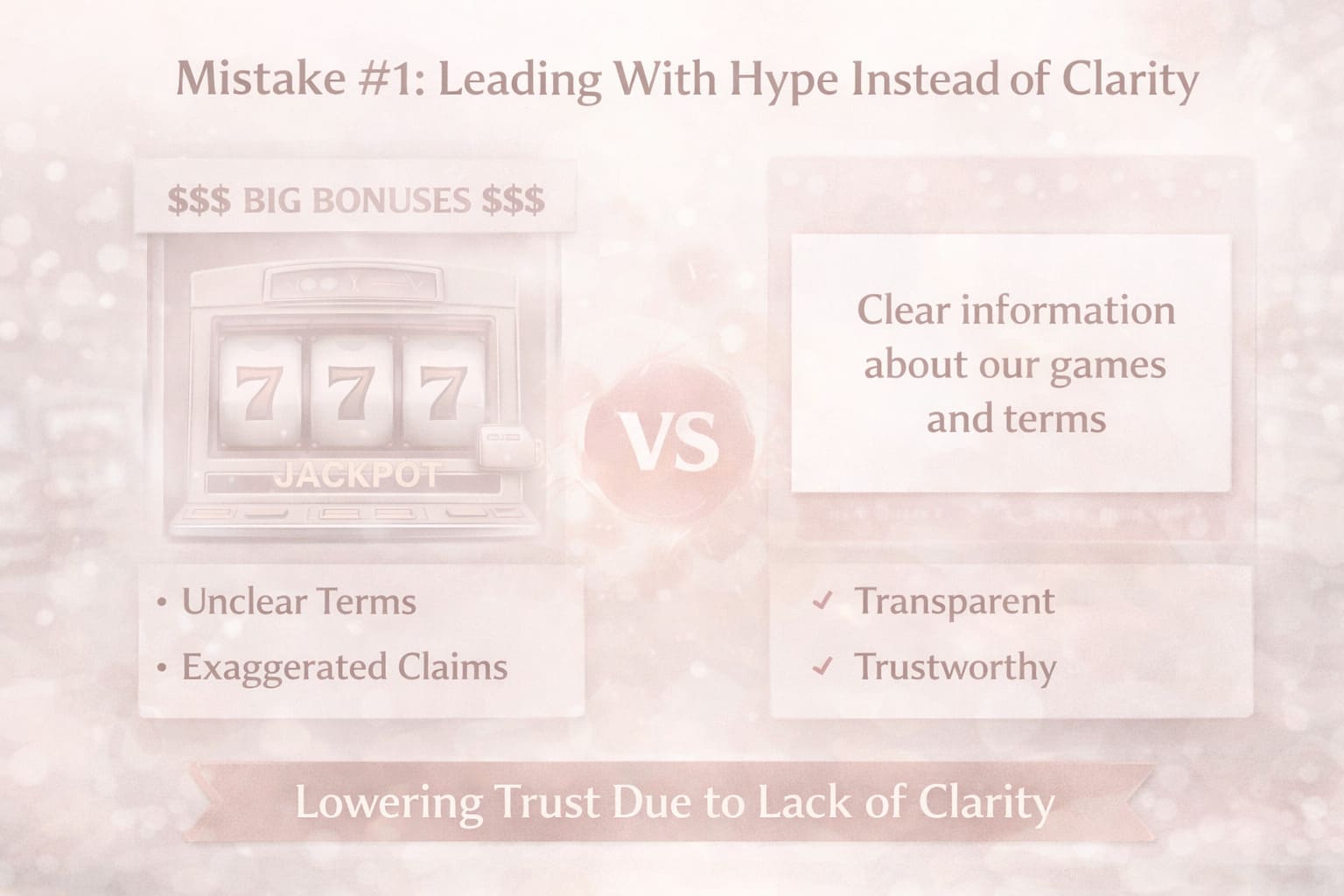
Many casino landing pages open with what you could call marketing fog: loud headlines (“Massive Bonuses Inside!”) that don’t specify what the offer actually is, who qualifies, or what happens after clicking the CTA. The assumption is that excitement will carry the user through registration — but excitement without structure produces confusion, and confusion triggers the back button.
Clarity means answering three questions above the fold: who this is for, what’s being offered, and what happens next. Compare:
- Fog: “Unbelievable Welcome Package Awaits!”
- Clarity: “New UK players: 100 free spins on Starburst. No deposit required. Winnings: 30x wagering. Ends Sunday.”
This doesn’t mean you have to kill persuasion. It means you embed persuasive language inside a structure that respects risk evaluation. When hype replaces clarity, you filter for impulsive clicks — not quality players who deposit, retain, and recommend.
Mistake #2: Trust Signals Are Missing — or They Look Like Props
Players arrive looking for reasons to distrust you. That’s not cynicism — it’s learned behavior shaped by scam sites, rogue operators, and “easy deposit / hard withdrawal” traps. Trust signals should reduce that anxiety, but many landing pages either omit them or present them in ways that feel decorative.

A licensing badge that isn’t clickable, doesn’t name the authority, or looks like generic clip art can create more suspicion than reassurance. The same applies to security certificates, payment logos, and responsible gambling messages. If users can’t verify a trust signal, it becomes a red flag.
- Licensing disclosure naming the authority (UKGC, MGA, etc.) with a clickable license number where possible
- Responsible gambling links to recognizable organizations (GamCare, BeGambleAware) from visible areas — not only footers
- Payment method trust cues with current branding and region-appropriate options
- Support availability shown plainly (“Live chat online now”, “24/7 support”, or hours if limited)
- Withdrawal expectations summarized in one sentence (typical processing times + verification note)
Placement matters. Put trust cues where anxious eyes naturally land: header, just under the CTA, and near bonus claims. If you hide trust under legal links, users assume it’s there because it’s bad news.
Mistake #3: Hiding Bonus Terms Until After Signup
Nothing damages credibility faster than a “100% match bonus up to $500” that turns into “50x wagering, slots-only, expires in 48 hours” after the account is created. Players either don’t convert because they anticipate the trap — or they convert and churn immediately after discovering conditions.
The alternative is upfront transparency, which often increases conversion because it reduces post-signup disappointment, refund attempts, and complaints. You don’t need to dump legal text above the fold — you need to surface the terms that change the decision: wagering, expiry, restrictions, and max cashout.
| Bonus Claim | What Users Assume | Common Hidden Catch | Trust-Safe Presentation |
|---|---|---|---|
| 200% match bonus | I deposit $100, I get $200 extra | 50x wagering, slots only, max bet $5 | “Deposit $100, play with $300. 50x wagering on bonus. Slots only.” |
| 100 free spins | I get 100 spins instantly | 10 spins/day for 10 days, 40x on winnings | “100 spins on Starburst, 10/day. Winnings: 40x wagering.” |
| No deposit bonus | Free money, no strings | Max cashout $50, ID needed before cashout | “$10 no-deposit bonus. Max withdraw $50. ID check required before withdrawal.” |
| Cashback offer | I get back what I lose | 10% net loss, paid as bonus funds | “10% cashback on weekly net losses, paid as bonus (1x wagering).” |
Mistake #4: Treating Withdrawals Like an Afterthought
For many players, the core question isn’t “How do I deposit?” It’s “Will I actually get paid?” Withdrawal anxiety is the dominant emotion in casino decision-making — and most landing pages either ignore it or bury payout information behind help pages that require login.
High-performing pages treat withdrawals as a confidence builder: they state typical timeframes (e-wallets in 24h, bank transfer 3–5 business days), explain verification in plain language, and clarify whether withdrawals are processed automatically or manually reviewed.
Players expect KYC in regulated markets. What they don’t tolerate is surprise friction — discovering after they win that withdrawals require additional forms, minimum thresholds, or long delays that were never mentioned. Transparency doesn’t reduce conversion. Surprise does.
Mistake #5: Too Many Popups, Banners, and Consent Friction
Cookie modal. Newsletter popup. Sticky promo bar. Pulsing chat widget. Exit-intent overlay. Each element may have been added by different teams with different KPIs, but together they create cognitive overload. The user can’t evaluate the offer because the page keeps interrupting them.
Sequence matters. Cookie consent should be simple and non-blocking where legally possible. Newsletter capture should wait until the user shows intent (scroll depth, time on page). Live chat should be helpful, not noisy — minimized by default, visible when users reach high-anxiety sections (withdrawals, verification, terms).
Dark-pattern consent designs (hard-to-find “reject all”, pre-checked toggles, consent walls) don’t just hurt conversion — they damage trust. In regulated markets, players increasingly interpret manipulative consent UX as a warning sign about how the casino handles money.
Mistake #6: Treating Mobile UX as a Resize Problem
Over 60% of casino traffic now comes from mobile. Yet many landing pages are still designed for desktop and squeezed down: text too small, buttons too close, forms that require excessive typing, and load times that punish users on cellular connections. Mobile isn’t a secondary experience — for many players, it’s the only one.

Mobile conversion lags not because mobile players are less serious, but because mobile experiences are often worse. Thumb reach matters. Autofill matters. Input types matter. Performance matters. Every “small” friction compounds.
- Touch targets at least 44×44 pixels, with spacing to prevent mis-taps
- Autofill-friendly forms with proper labels and password manager support
- Correct keyboard types (numeric for amounts, email keyboard for email)
- Single-column layout with no horizontal scrolling or zoom
- Page weight discipline (aim under ~2MB for first load on mobile)
- Lazy loading for below-the-fold images and non-critical scripts
- Stable layout to prevent mis-clicks from CLS shifts
Mistake #7: Forms That Feel Like Interrogation (Too Early)
Some landing flows demand full personal details instantly — name, address, DOB, phone, employment, source of funds — before users even explore games. Even when driven by compliance, this can feel like interrogation before invitation. Players who might comply later abandon early.
The conversion-friendly approach is progressive disclosure: collect minimal info to create an account, then expand requirements when intent is proven (deposit/withdrawal). Where early collection is unavoidable, microcopy is your lever. “Source of Funds” with no explanation feels invasive. “We ask this to comply with AML rules and protect players” feels justified.
Mistake #8: Slow Pages, Broken States, and Vague Errors
Performance is a trust signal. A landing page that takes six seconds to load signals “cheap, unstable, risky” — even before users see the offer. Broken states and vague errors amplify that fear.
Core Web Vitals matter because they align with real user frustration thresholds. Aim for fast rendering, instant interaction feedback, and stable layout. Also: error messages should be human, not technical. “Error 500” is not an acceptable conversion experience.
| UX Failure | What It Signals | What Users Do | Better Handling |
|---|---|---|---|
| Page loads >5 seconds | Unreliable platform | Close tab quickly | Compress images, defer JS, use CDN, lazy load |
| Form submits → “Error 500” | Data loss risk | Assume unsafe, abandon | Friendly copy + retry + support link |
| No click feedback | Interaction failed | Double-click, create duplicates | Immediate loading state + disabled button |
| Layout shifts | Unprofessional, risky | Mis-tap, lose confidence | Reserve space, load fonts correctly |
| “Username taken” at the end | Wasted time | Quit instead of retry | Inline validation before submit |
Mistake #9: No Clear Path to Human Support
Players have anxiety questions: legality, verification time, withdrawal delays, limits, payment failures. Many will only convert if they can confirm answers fast. If support is hidden behind a login wall or chat is a bot that loops, players interpret it as “you’re on your own.”
Even without using chat, seeing real support availability reduces risk perception. Make support visible pre-signup, show response expectations, and link to high-value FAQs (verification, withdrawals, bonus terms).
Mistake #10: The Page Doesn’t Match the Ad (Message Mismatch)
Message mismatch is an instant bounce trigger. If the ad says “50 free spins no deposit” and the landing page opens with “Welcome bonus up to $1,000,” users assume bait-and-switch. They won’t scroll to “find the real offer.”
Fix this by building message-matched variants: headlines, visuals, and above-the-fold copy aligned with the ad promise. If the ad is market-specific, the page should be market-specific. Continuity builds trust.
A Practical Fix-It Checklist (What to Change First)
If you can’t fix everything at once, prioritize by impact-to-effort. These are the most common high-leverage improvements:
- Make the primary CTA visible above the fold on both desktop and mobile
- Surface key bonus terms (wagering, expiry, restrictions) next to the bonus claim
- Make licensing details verifiable (authority name + clickable verification where possible)
- Add a withdrawal summary (typical processing times + verification note) pre-signup
- Reduce popups and sequence them based on intent signals (scroll depth, time on page)
- Shorten initial signup to the minimum fields possible; defer the rest
- Improve error UX with human language and clear next steps
- Build message-matched landing variants for key campaigns
- Make support visible pre-signup, with response expectations
If you reference access flows or authentication UX as part of your friction audit, use neutral language and keep it user-benefit focused — for instance, you can mention how clean login UX reduces support tickets (e.g., the way a well-structured the pokies net login page typically clarifies errors and next steps) without turning it into a promotional tangent.
Conclusion
Casino landing page conversion isn’t primarily about persuasion — it’s about removing barriers to trust. Players already arrive motivated by entertainment and potential winnings. What stops them is uncertainty: hidden terms, missing verification expectations, unclear withdrawals, aggressive consent design, slow performance, and message mismatch.
The best-converting operators treat clarity as a competitive advantage. They surface the truth early, remove surprise friction, and design for anxious users rather than wishful clicks. In a regulated, high-trust-cost niche, honesty is not only ethical — it’s a conversion strategy.