

Indoor air pollution is a silent threat that affects millions of homes worldwide. According to the Environmental Protection Agency, indoor air can be 2-5 times more polluted than outdoor air, making indoor air quality monitors essential tools for maintaining a healthy living environment. These devices detect harmful pollutants, allergens, and gases that accumulate inside our homes, helping us take proactive measures to protect our families’ health.
What Is an Indoor Air Quality Monitor and Why You Need One
An indoor air quality monitor is a sophisticated device that continuously measures various airborne pollutants and environmental conditions within your home. These monitors use advanced sensors to detect invisible threats that can compromise your health and comfort, providing real-time data and alerts when air quality deteriorates.
| Pollutant Type | What It Is | Common Sources | Health Impact |
|---|---|---|---|
| PM2.5/PM10 | Fine particulate matter | Cooking, smoking, dust | Respiratory issues, heart problems |
| CO2 | Carbon dioxide | Human breathing, combustion | Drowsiness, headaches, cognitive impairment |
| VOCs | Volatile organic compounds | Paints, cleaners, furniture | Eye irritation, nausea, organ damage |
| Humidity | Moisture level | Cooking, bathing, weather | Mold growth, respiratory discomfort |
| Radon | Radioactive gas | Soil, building materials | Lung cancer risk |
How Indoor Air Quality Impacts Your Health
Poor indoor air quality is linked to numerous health complications. Short-term exposure to elevated pollutant levels can trigger allergies, asthma attacks, eye irritation, and headaches. Children, elderly individuals, and those with pre-existing respiratory conditions are particularly vulnerable. Long-term exposure presents even more serious risks, including chronic respiratory diseases, cardiovascular problems, and increased cancer risk from pollutants like radon and certain VOCs. Research published by the World Health Organization indicates that household air pollution contributes to millions of premature deaths annually worldwide.
Key Metrics Air Quality Monitors Measure
Modern air quality monitors track multiple environmental parameters:
- PM2.5 and PM10: Fine and coarse particulate matter that penetrates deep into lungs, measured in micrograms per cubic meter (μg/m³)
- Carbon Dioxide (CO2): Indicates ventilation effectiveness and human occupancy, measured in parts per million (ppm)
- Volatile Organic Compounds (VOCs): Chemical gases from household products, measured in ppb or as an index score
- Temperature and Humidity: Essential for comfort and preventing mold growth, measured in degrees and percentage
- Formaldehyde: Common indoor pollutant from furniture and building materials
- Radon: Radioactive gas requiring specialized detection for long-term monitoring
How to Choose the Best Indoor Air Quality Monitor
Selecting the right monitor depends on your specific needs, budget, and the pollutants most relevant to your environment. Understanding the technology behind these devices and their capabilities ensures you invest in a solution that delivers accurate, actionable insights.
Sensor Types and Accuracy
Sensor technology determines measurement precision and reliability. High-quality monitors use NDIR (Non-Dispersive Infrared) sensors for CO2 detection, which provide laboratory-grade accuracy. For particulate matter, laser scattering technology offers superior precision compared to cheaper infrared LED sensors. VOC sensors typically use metal oxide semiconductors or electrochemical cells, with the latter providing more accurate readings. Premium monitors incorporate multiple sensor types for comprehensive air quality assessment, while budget options may use estimation algorithms that sacrifice accuracy for affordability.
Connectivity & Smart Features
Modern air quality monitors offer various connectivity options that enhance functionality. Wi-Fi-enabled devices sync with smartphone apps, allowing remote monitoring and historical data analysis. Smart home integration with platforms like Apple HomeKit, Amazon Alexa, and Google Home enables automated responses—triggering air purifiers or adjusting HVAC systems when pollution levels rise. Advanced features include customizable alerts, exportable data for detailed analysis, and multi-room monitoring capabilities.
Display, Power & Portability
Consider these practical aspects when choosing your monitor:
- Display quality: Color-coded screens with clear numerical readings versus basic LCD displays
- Power options: Battery-powered units for portability versus plug-in models for continuous monitoring
- Form factor: Compact portable designs for room-to-room assessment versus stationary monitors for permanent placement
- Battery life: Ranges from days to months depending on display usage and connectivity features
- Mounting options: Tabletop, wall-mounted, or versatile placement capabilities
Top Indoor Air Quality Monitors Recommended in 2025
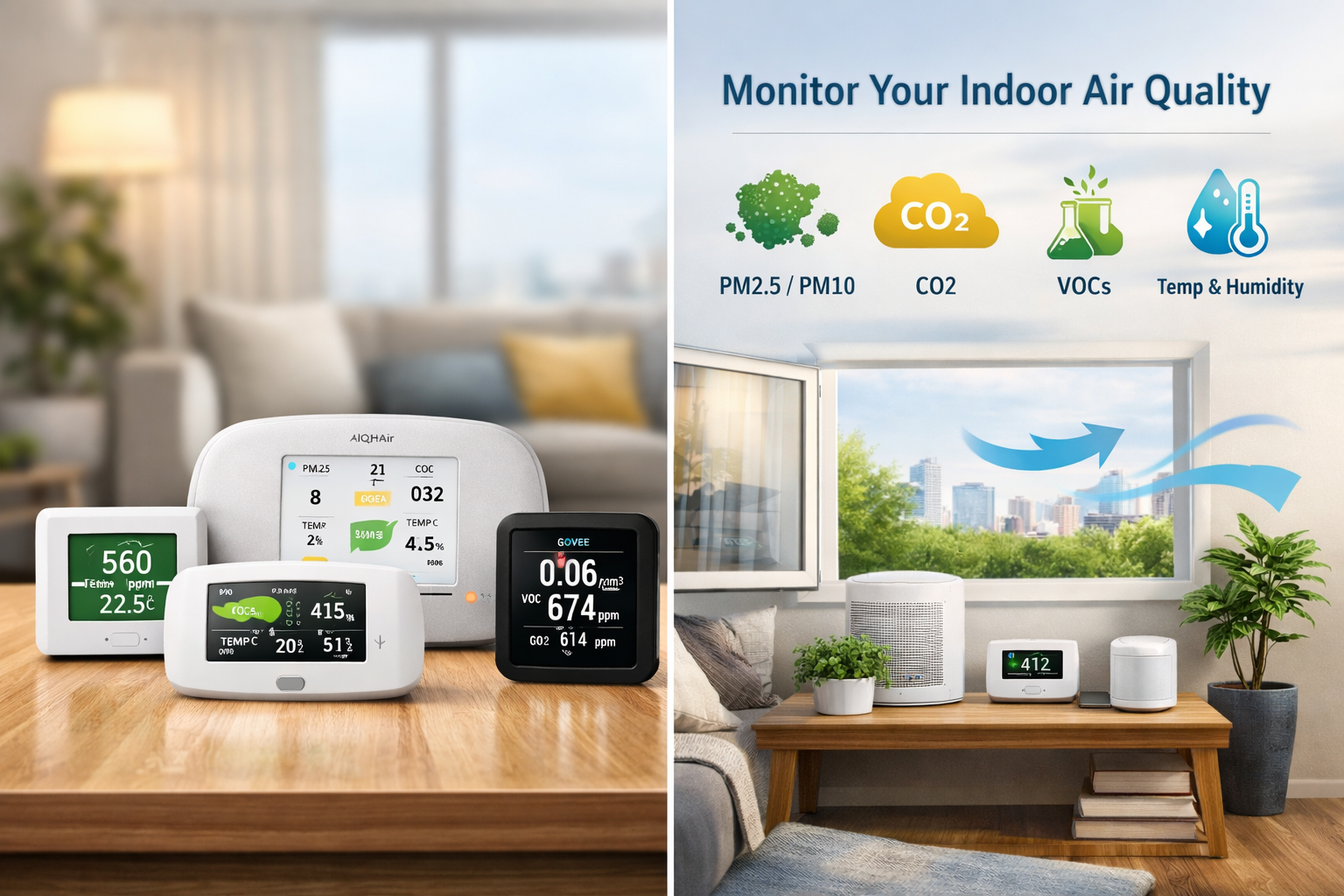
Based on comprehensive testing and user feedback, the following monitors represent the best options across various price points and feature sets. Each device excels in specific areas, ensuring there’s an ideal solution for every home and budget.
| Monitor | Key Sensors | Connectivity | Price Range | Best For |
|---|---|---|---|---|
| Airthings View Plus | Radon, PM, CO2, VOCs | Wi-Fi, app | $$$ | Comprehensive monitoring |
| Qingping Air Monitor Lite | PM2.5, CO2, temperature | Wi-Fi, smart home | $$ | Smart home integration |
| Amazon Smart Air Quality Monitor | PM2.5, VOCs, CO, humidity | Alexa, Wi-Fi | $ | Alexa ecosystem users |
| IQAir AirVisual Pro | PM2.5, CO2, temperature | Wi-Fi, app | $$$$ | Professional accuracy |
| Temtop M2000 | PM2.5/PM10, CO2, formaldehyde | Standalone | $$ | Portable assessment |
Best Overall Indoor Air Quality Monitor
The Airthings View Plus stands out as the most comprehensive solution for homeowners serious about air quality. This monitor uniquely detects radon, a leading cause of lung cancer, alongside PM2.5, CO2, VOCs, humidity, and temperature. Its intuitive app provides detailed insights with historical trends and personalized recommendations.
Standout features include:
- Professional-grade radon sensor with long-term tracking
- Color-coded display for at-a-glance status checks
- Battery-powered operation lasting up to two years
- Integration with IFTTT for automated home responses
- Detailed air quality scoring with actionable improvement tips
Best Professional-Grade / Smart Home Monitor
The IQAir AirVisual Pro delivers laboratory-grade accuracy with Swiss-engineered sensors. Its large touchscreen displays real-time outdoor pollution data alongside indoor measurements, helping you optimize ventilation timing. Professional features include data export capabilities, customizable alerts, and compatibility with building management systems, making it ideal for offices and tech-savvy homeowners.
Best Mid-Range Monitors With Versatile Features
The Qingping Air Monitor Lite offers excellent value with accurate CO2 and PM2.5 detection, seamless smart home integration, and an elegant minimalist design. Its HomeKit and Matter compatibility ensures future-proof connectivity.
The Awair Element excels at tracking how air quality affects sleep quality, providing insights into overnight CO2 buildup and temperature fluctuations. Its compact form factor and detailed app analytics make it perfect for bedroom monitoring.
Best Budget-Friendly & Compact Options
The Amazon Smart Air Quality Monitor provides essential measurements at an accessible price point. Best suited for:
- Alexa smart home users seeking automated air purifier control
- First-time air quality monitoring
- Basic PM2.5 and VOC detection needs
The Temtop M2000 offers portable, battery-powered monitoring with a comprehensive sensor array including formaldehyde detection—ideal for testing multiple rooms or rental properties.
Other Worthwhile Monitors for Specific Needs
- Eve Room: Perfect for Apple HomeKit enthusiasts with Thread connectivity
- Netatmo Smart Indoor Air Quality Monitor: Long-term CO2 monitoring with acoustic comfort tracking
- uHoo 9-in-1: Most comprehensive sensor array including ozone and NO2 detection
- Sensibo Elements: Integrated with air conditioning control for automated climate optimization
Indoor Air Quality Monitor Features Comparison
| Feature | Entry-Level | Mid-Range | Premium |
|---|---|---|---|
| Sensors | PM2.5, humidity | PM, CO2, VOCs, temp/humidity | All standard + radon/formaldehyde |
| Connectivity | Basic or none | Wi-Fi, app | Wi-Fi, smart home, cloud |
| Display | Basic LCD | Color screen | Large touchscreen |
| Price | $50-$100 | $150-$250 | $300-$400+ |
| Best Use | Single-room monitoring | Whole-home tracking | Professional/comprehensive analysis |
How to Install and Use Your Air Quality Monitor for Best Results
Proper placement and usage maximize your monitor’s effectiveness. Follow these guidelines to ensure accurate readings and meaningful insights into your home’s air quality.
Ideal Placement in Your Home
Position your monitor in breathing zones—approximately 3-6 feet off the ground where you spend the most time. Avoid placing devices directly next to windows, doors, air vents, or in kitchens where cooking temporarily skews readings. For comprehensive coverage, prioritize bedrooms where you spend 6-8 hours nightly, followed by living areas and home offices. Keep monitors away from direct sunlight and humidity sources like bathrooms for consistent measurements.
Interpreting Readings and Taking Action
- Establish baseline readings over several days to understand your home’s normal air quality patterns
- Learn threshold values: CO2 above 1000 ppm indicates poor ventilation; PM2.5 above 35 μg/m³ is unhealthy
- Respond to alerts promptly by opening windows, activating air purifiers, or identifying pollution sources
- Track trends rather than fixating on momentary spikes—cooking and cleaning cause temporary elevations
- Correlate readings with symptoms to identify specific triggers for allergies or respiratory issues
- Schedule HVAC maintenance when CO2 levels consistently exceed recommended levels
Frequently Asked Questions (FAQs)
- Do all air quality monitors measure CO2? No, budget models often omit CO2 sensors. Check specifications if ventilation monitoring is important to you.
- How often should I check readings? Once or twice daily is sufficient for stationary monitors with apps that track historical data and send alerts.
- Can these replace smoke or CO alarms? Absolutely not. Air quality monitors don’t detect fire or life-threatening carbon monoxide levels requiring dedicated safety alarms.
- Are expensive monitors worth the investment? Premium monitors provide more accurate sensors, additional pollutant detection, and better smart home integration—worthwhile for households with respiratory sensitivities.
- How long do air quality monitors last? Most devices function for 5-10 years, though sensors may require calibration or replacement after 3-5 years of continuous use.
Conclusion
Investing in the right indoor air quality monitor empowers you to create a healthier home environment for your family. Whether you need comprehensive radon detection, smart home automation, or budget-friendly basic monitoring, 2025 offers exceptional options across all price points. Start by identifying your primary concerns—allergies, ventilation, or specific pollutants—then select a monitor that addresses those needs with accurate sensors and useful features. Better air quality monitoring leads to informed decisions that protect long-term health and improve daily comfort.